19. Pelops

tantalus

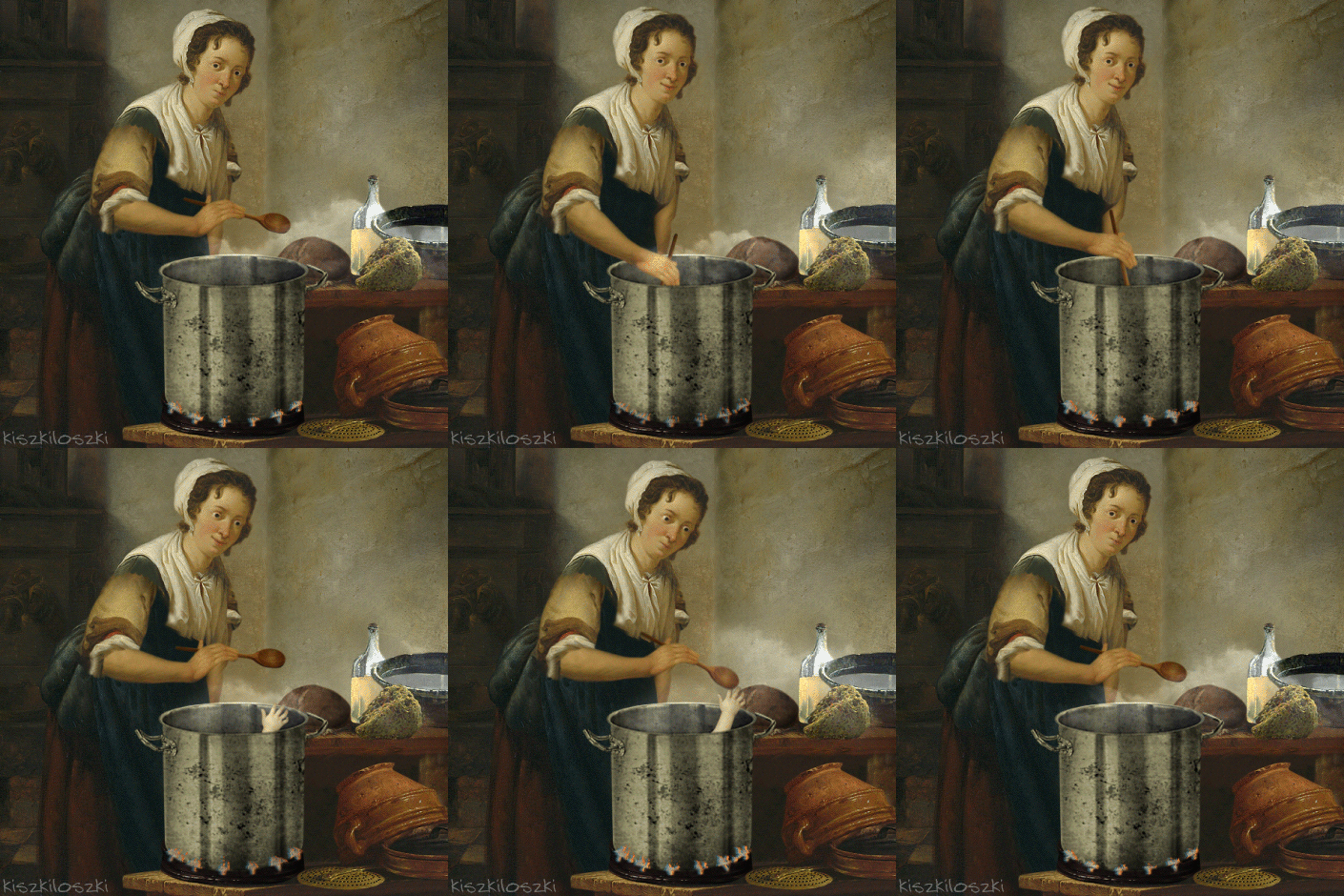
Pelops who? Meet this lesser known Greek hero-king who lends his name to the Peloponnese and is connected to the founding of the Olympic games. Was he really chopped up by his father and served to the gods or is something else going on?

(gif via http://kiszkiloszki.tumblr.com)

https://www.podbean.com/media/player/rq643-675af1?from=yiiadmin

Download this episode (right click and save)


Source Passage

Pindar. Olympian Ode 1.


Translation Sources

Pindar. “Olympian Ode 1.” Greek Lyric: An Anthology in Translation. Trans. Andrew Miller. Indianapolis: Hackett, 1996. 126-131.


News & Shout-Outs

We are now on Patreon! If you like what you hear, please consider supporting us. Our current goal is to offset our increased hosting fees as our little podcast continues to grow.

img_1016

Join us on Twitter @InnesAlison and @darrinsunstrum or #MythTake.

We’re a part of the #HumanitiesPodcasts podcasting community. Check out the hashtag and follow @HumCommCasters to find many more engaging and knowledgeable podcasts.

We’re on Facebook! Give us a like, let us know what you think, and follow along at MythTake.

Subscribe on iTunes , Stitcher, or Google Play so you don’t miss an episode! Find our RSS on Podbean.

Like what you hear? Support us on Patreon.

This week’s theme music: “Super Hero” by King Louie’s Missing Monuments from the album “Live at WFMU” (2011). Used under Creative Commons license. Music used under Creative Commons license and available from Free Music Archive.
MythTake Drive-Time Episode 1 “Shapes of Stories”


Darrin shares his thoughts about myth in this new series of bit-sized pieces!

We’re now on Stitcher!

Exciting news! We are now available on Stitcher! 

http://www.stitcher.com/s?fid=129735&refid=stpr

Don’t miss an episode!
We’ll have a new episode up soon! 

18. homeric hymn to dionysus

img_6482

In our current episode of MythTake we discuss the ‘arrival’ of Dionysus as depicted in the Homeric Hymn #7. The Hymn describes a young, strong and beautiful god who is abducted by pirates for ransom. Long story short, it doesn’t quite work out for the pirates and yet again we see the after effects of a divine encounter.

In the course of a few lines these men and their vessel are transformed, literally in the case of the crewmen, into dolphins; and figuratively – the helmsman will become the prototypical priest of Dionysus. The Captain– well let’s just say that he too becomes transformed. He is consumed, digested by the god. 

These metamorphoses as a result of a divine epiphany are again quite common in the mythical corpus. Hesiod’s encounter with the Muses on the slopes of Mt. Helicon, The Cretan sailors in the Homeric Hymn to Apollo and others. In the presence of divinity humans often find themselves ‘altered’. Their paths through life take a turn, they become something else. Shepherds become poets, sailors become priests, helmsman become baccantes, predators become prey – you get the picture.

As we discussed the passage it became quite evident that there are many mythological elements that this small hymn (of 49 lines) has in common with other sources. These metonymical connections spread out from this hymn (like the ivy covering the ship’s mast) and work their way into Hesiod, Euripides, Ovid, Apollodorus and beyond. [DS]


https://www.podbean.com/media/player/jjday-665df6?from=yiiadmin

Download this episode (right click and save)


Source Passage

Homeric Hymn to Dionysus (Hymn 7)

Ovid. Metamorphoses. 3. 845-863.

Apollodorus. Library of Greek Mythology. 3.5.3


Translation Sources

Apollodorus. The Library of Greek Mythology. Translated by Robin Hard. Oxford World’s Classics: 1997.

Homeric Hymn to Dionysus. Translated by Susan C. Shelmerdine. Focus Publishing: 1995.

Ovid. Metamorphoses. Translated by Charles Martin. Norton: 2004.


img_1016

Join us on Twitter @InnesAlison and @darrinsunstrum or #MythTake.

We’re a part of the #HumanitiesPodcasts podcasting community. Check out the hashtag and follow @HumCommCasters to find many more engaging and knowledgeable podcasts.

We’re on Facebook! Give us a like, let us know what you think, and follow along at MythTake.

Subscribe on iTunes or Google Play so you don’t miss an episode! Find our RSS on Podbean.

This week’s theme music: “Super Hero” by King Louie’s Missing Monuments from the album “Live at WFMU” (2011). Used under Creative Commons license. Music used under Creative Commons license and available from Free Music Archive.


17. Heroes at Home: Deianira

This week we meet an unlikely hero, Deianara. Can this fearful, anxious woman, blamed for the death of Heracles, be considered a hero? We think so!

https://www.podbean.com/media/player/ne7nu-66085f?from=yiiadmin

Download this episode (right click and save)


Source Passages

Sophocles Trachiniae (Women of Trachis) 1-48, 436-469.


Translation Sources

Sophocles. Women of Trachis. Translated by Michael Jameson. Edited by Greene and Lattimore. Chicago, 1957.


Selected Sources

Edwin Carawan. “Deianira’s Guilt.” Transactions of the American Philological Association 40 (130): 2000, 189-237.


Shout Outs & Notes

Literature and History podcast by Doug Metzger

The History of Ancient Greece podcast by Ryan Stitt

The Story Behind podcast by Emily

The Lonely Pallet podcast by Tamar Avishai

The new @HumCommCasters community! Find new humanities podcasts to listen to and network with fellow humanities podcasters.


Join us on Twitter @InnesAlison and @darrinsunstrum or #MythTake.

We’re a part of the #HumanitiesPodcasts podcasting community. Check out the hashtag and follow @HumCommCasters to find many more engaging and knowledgeable podcasts.

We’re on Facebook! Give us a like, let us know what you think, and follow along at MythTake.

Subscribe on iTunes or Google Play so you don’t miss an episode! Find our RSS on Podbean.

This week’s theme music: “Super Hero” by King Louie’s Missing Monuments from the album “Live at WFMU” (2011). Used under Creative Commons license. Music used under Creative Commons license and available from Free Music Archive.

ancient world podcasts

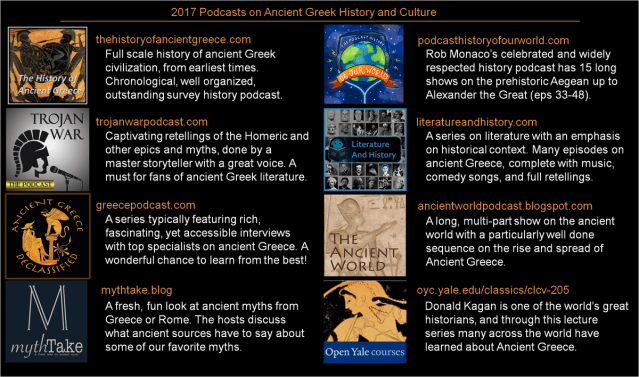
Treat yourself to some new podcast listening! Our friends over at the Literature and History podcast put together this handy infographic of some of the best podcasts about the ancient world.

c08aspaviaam2hb

Quick links:

The History of Ancient Greece (Ryan Stitt)

Podcast History of Our World (Rob Monaco)

Trojan War Podcast (Jeff Wright)

Literature and History (Doug Metzger)

Ancient Greece Declassified (Jason Webley)

The Ancient World (Scott C.)

MythTake (Alison Innes & Darrin Sunstrum)

Open Yale Courses–Introduction to Ancient Greek History (Donald Kagan)

16. heroes at home: helen of troy

img_6482

We continue our look at heroes at home with the woman who needs no introduction, the (in)famous Helen of Troy.

https://www.podbean.com/media/player/mdacv-654060?from=yiiadmin

Download this episode (right click and save)


Source Passages

Euripides’ Trojan Women lines 914-965.


Translation Sources

Euripides. Trojan Women. Translated by Diskin Clay. Focus, 2005.


Join us on Twitter @InnesAlison and @darrinsunstrum

We’re now on Facebook! Give us a like, let us know what you think, and follow along at MythTake.

Join us on Twitter @InnesAlison and @darrinsunstrum

We’re now on Facebook! Give us a like, let us know what you think, and follow along at MythTake.

Subscribe on iTunes or Google Play so you don’t miss an episode! Find our RSS on Podbean.

This week’s theme music: “Super Hero” by King Louie’s Missing Monuments from the album “Live at WFMU” (2011). Used under Creative Commons license. Music used under Creative Commons license and available from Free Music Archive.

15. heroes at home: megara

Join our informal discussion on heroes of the home! Tonight we chat about Megara, the first wife of Heracles, from Euripides’ Heracles.

https://www.podbean.com/media/player/zvvbk-649d57?from=yiiadmin

Download this episode (right click and save)


Source Passages

Euripides Heracles 275-311, 516-561.


Translation Sources

Euripides. Heracles. Translated by Michael R. Halleran. Focus Classical Library. 1988.


Shout Outs & Notes

Ellie Mackin “Odysseus doesn’t go to the Underworld in the Nekyia, peeps!” Blog post.


Join us on Twitter @InnesAlison and @darrinsunstrum

We’re now on Facebook! Give us a like, let us know what you think, and follow along at MythTake.

Subscribe on iTunes or Google Play so you don’t miss an episode! Find our RSS on Podbean.

This week’s theme music: “Super Hero” by King Louie’s Missing Monuments from the album “Live at WFMU” (2011). Used under Creative Commons license. Music used under Creative Commons license and available from Free Music Archive.

14. Hallowe’en Special: Necromancy in Greek Mythology

img_6482C’est l’Hallowe’en! We have a special spooky episode for you this week: two episodes of necromancy from Greek mythology! Follow the spell-binding details (haha!) of Odysseus’ encounter with the dead and Jason’s summoning of Hekate in Argonautika.

Have a safe and spooktacular Hallowe’en!

https://www.podbean.com/media/player/d77kq-6414dc?from=yiiadmin

Download this episode (right click and save)


Source Passages

Odyssey 11.13-50

Arognautika 3.1026-1049, 1194-1224


Translation Sources

Apollonios Rhodios. Argonautika. Trans. Peter Green. University of California, 2007.

Homer. Odyssey. Trans. Richmond Lattimore. Harper Perennial Classics, 1967.


Shout Outs & Notes

Listener mail from @EllieMackin–you should follow her!


Join us on Twitter @InnesAlison and @darrinsunstrum

We’re now on Facebook! Give us a like, let us know what you think, and follow along at MythTake.

Subscribe on iTunes so you don’t miss an episode!

Subscribe on Google Play 

Find our RSS on Podbean

This week’s theme music: “Super Hero” by King Louie’s Missing Monuments from the album “Live at WFMU” (2011). Used under Creative Commons license. Music used under Creative Commons license and available from Free Music Archive.